- This event has passed.
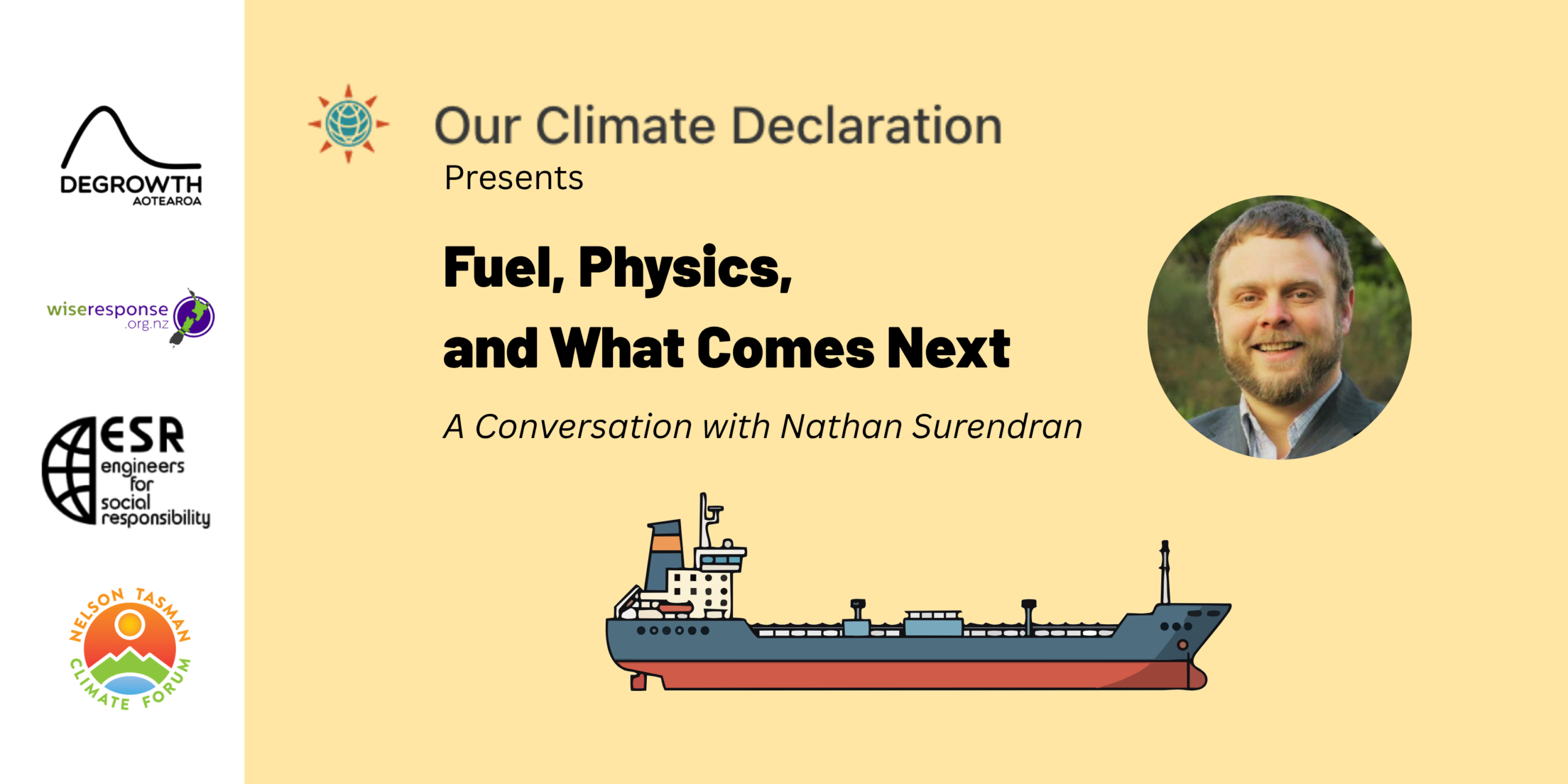
WEBINAR – Fuel, Physics, and What Comes Next, with Nathan Surendran
Join the discussion on Zoom by registering here.
Nathan is an energy engineer and Chair of the Wise Response Society who has been writing extensively about the current energy crisis and its implications (see below)
NZ will probably hit its climate targets. Not because of good policy, but because the economy is being forced into contraction by an energy crisis that mainstream institutions didn’t see coming – or chose not to. Nathan Surendran connects the immediate fuel emergency to the biophysical economics that conventional policy ignores: declining energy returns, thermodynamic constraints on transition, and a coming wave of insolvency and default that may cause more damage than fuel shortages themselves. He presents practical tools for community resilience, from mutual aid frameworks to fair rationing mechanisms, and argues that the response must start at the community level because government is not going to lead it.
OUTLINE: Be Prepared for a Lively Discussion
1. The good news on climate (that nobody wants to hear)
NZ is likely to meet its climate targets. Not because of policy. Because the economy is falling off a cliff. Energy price-driven demand destruction is cutting emissions faster than any government programme. Diesel above $4/litre, petrol not far behind. Businesses are closing, freight is contracting, discretionary travel has collapsed. When you can’t afford to burn fuel, you don’t burn fuel. Emissions fall. This is the climate trajectory nobody modelled – involuntary degrowth driven by energy supply disruption and price shock.
2. Why this is happening – the energy supply picture
The Strait of Hormuz closure and the wider Middle East conflict have taken out a significant share of global crude and LNG supply. NZ imports 100% of its refined fuel. 81% comes from refineries processing Middle Eastern crude. We have roughly 18 days of diesel physically onshore. The government’s fuel plan has no volumetric allocations. Force Majeure declarations have cascaded across every link in our supply chain. I’ve been tracking this in detail:
– “The Limits to the Energy Transition” (white paper): https://energyandresilience.substack.com/p/the-limits-to-the-energy-transition
– “Hoping the Ship Arrives Isn’t a Strategy”: https://energyandresilience.substack.com/p/hoping-the-ship-arrives-isnt-a-strategy
– “Every Country in Our Supply Chain Has Declared an Emergency”: https://energyandresilience.substack.com/p/every-country-in-our-supply-chain
3. The default tsunami – the crisis before the shortage
Everyone is watching fuel gauges. But the more immediate shock may be financial. NZ insolvencies were at a 15-year high before Hormuz. Mortgage arrears at an 8-year peak. IRD tax debt past $9 billion. Household debt at 165-170% of disposable income. There was no buffer. When diesel costs flow through to freight, food, fertiliser, and farm input costs, the wave of business failures and mortgage defaults will hit before physical fuel shortages do. I’m publishing a piece on this shortly – “The Default Tsunami” – arguing we’re watching the wrong metric.
4. The deeper structure – biophysical economics
This isn’t a one-off geopolitical shock. It’s the predictable consequence of building a civilisation on a depleting energy resource. EROI decline means we spend more energy to get energy. The economy is an energy system using money, not a financial system using energy. The “seamless transition” narrative assumes the global supply chains, fossil fuel inputs, and critical minerals needed for transition will keep flowing. They are not flowing. Drawing on Hall, Keen, Smil, Hagens, Garrett, Delannoy.
– White paper covers this in depth: https://energyandresilience.substack.com/p/the-limits-to-the-energy-transition
5. What we can do – community resilience and policy
– Wise Response open letter: quantified essential use fuel allocation plan (with Mike Hodgkinson, Laloli Research)
– Tradable Energy Quotas (TEQs) as fair rationing: https://wiseresponse.substack.com (TEQs article)
– “When the Trucks Stop” mutual aid guide https://open.substack.com/pub/wiseresponse/p/what-can-i-do-in-response-to-the
– “No Fuel, Still Fed” https://energyandresilience.substack.com/p/no-fuel-still-fed regional food security framework
– Local action: council deputations, community preparedness networks
– Demand reduction, negawatts, fuel-free pathways
This webinar is organised by Our Climate Declaration
and co-sponsored by: